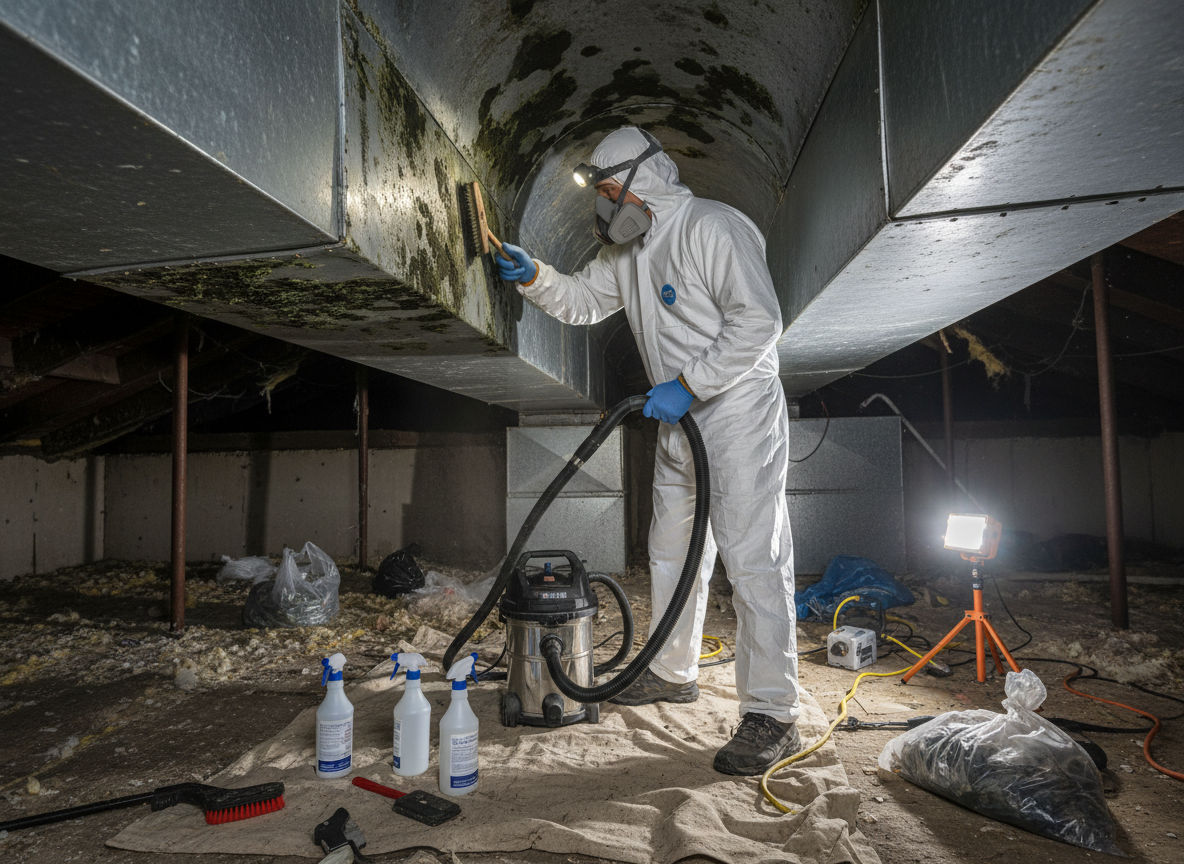
Tujunga homes in Tujunga Village and Foothill Trails often feature older duct runs routed through unconditioned attics that sit close to the Angeles National Forest. Hot dry summers drive residents to run air conditioning for long stretches, then mild winter nights create temperature swings that leave condensation on metal ducts and flex lines. When insulation around those lines compresses or gaps open, spores settle and grow inside the airstream. Remediation here requires isolating each branch run, removing contaminated liner, and treating the sheet metal without releasing particles into living spaces that back up against the Tujunga Wash.
Access is frequently limited by low-slope roofs and hillside lots common in Sunland and Shadow Hills. Technicians must work from the exterior where possible, using negative-air machines tied to existing roof vents rather than cutting new holes that could affect seismic straps required in Los Angeles County. Edge cases include mold that has traveled into wall chases serving second-story bedrooms and mold that has colonized the blower compartment after a condensate pan overflow. In both situations the return-side insulation must be replaced because cleaning alone leaves enough residual growth to re-contaminate the system once humidity rises again.
Homeowners sometimes attempt to fog ducts themselves with over-the-counter products. These treatments rarely reach the far ends of runs that snake around the Bolton Hall Museum area’s older framing and can drive spores deeper into porous liner. Proper work includes removing and disposing of lined sections, HEPA vacuuming the bare metal, and applying an EPA-registered antimicrobial followed by new insulation that meets current fire codes. Post-remediation verification uses ATP swabs and visual inspection with a borescope so residents in Sylmar and nearby neighborhoods know the system is truly clear before the next seasonal temperature swing.
After the initial containment, crews seal all supply and return registers with tape and plastic to maintain pressure differentials. This step is critical on windy days when dust from the national forest can be pulled into any opening created during liner removal. Final clearance includes running the system for several hours with new filters installed so any remaining loose material is captured before the home is reoccupied.
Technician insight
In Tujunga the thing that catches most people out with ventilation mold remediation is how the mild winters let condensation sit in attic ducts that run along the cooler north-facing slopes of Foothill Trails homes built before the 1970s, especially where the Tujunga Wash keeps the air damper than the rest of Los Angeles County.
Musty Odor in Sunland Attic Ducts
A homeowner in Sunland reported a persistent musty smell when the furnace kicked on. Inspection showed condensation on uninsulated flex runs in the attic that had allowed mold to colonize the liner. Crews isolated the system, removed the affected sections, treated the metal, and reinstalled code-compliant insulation. The odor disappeared and follow-up testing cleared the ventilation.
How it works
- 1
Inspection and Containment
Technicians arrive 24/7 at the Foothill Blvd address and set up negative air at exterior vents before opening any ductwork in Tujunga homes.
- 2
Removal of Contaminated Liner
Affected insulation and flex duct sections are cut out and bagged on site, with special care for runs that travel near the Tujunga Wash floodplain.
- 3
Surface Treatment and Drying
Bare metal is HEPA-vacuumed and treated, then dried with dehumidifiers sized for the attic volume typical of Foothill Trails construction.
- 4
Re-insulation and Testing
New insulation is installed and the system is run under negative pressure while clearance samples are collected.
Pricing
Pricing varies with the number of duct runs, attic access difficulty on hillside lots, and whether lined sections must be replaced.